Email Continuity for Regulated Industries
Regulatory frameworks like Australia's APRA CPS-230, HIPAA, and FINRA require that regulated entities maintain documented, tested communication continuity plans. Email is rarely listed by name — but when payments, claims processing, customer communications, or fund administration depend on it, email infrastructure becomes part of your critical operations obligation.
We design and deploy email continuity infrastructure on a consulting basis, tailored to your specific regulatory context, at your facility of choice — including your own data center or a colocation facility in your jurisdiction.
What CPS-230 Requires (and Why Email Matters)
APRA's Prudential Standard CPS-230, in force from 1 July 2025, applies to all APRA-regulated entities — banks (ADIs), insurers, superannuation trustees, and private health insurers. It replaced the previous fragmented outsourcing and business continuity standards with a single unified framework built around three pillars:
Pillar 1: Operational Risk Management
Entities must identify, assess, and manage operational risks across all systems. IT capability — including email infrastructure — must be appropriate to current and projected business requirements and meet CPS-234 information security obligations.
Pillar 2: Business Continuity Planning
Entities must maintain a register of critical operations, hold a credible and regularly tested BCP, and continue critical operations within defined tolerance levels through severe disruptions. Email failover is a testable, documentable BCP component.
Pillar 3: Material Service Provider Management
Entities must submit a material service provider register to APRA. Vendors supporting critical operations must provide formal SLAs, incident notification commitments, and evidence of their own resilience capabilities.
Choosing the Right Filtering Layer
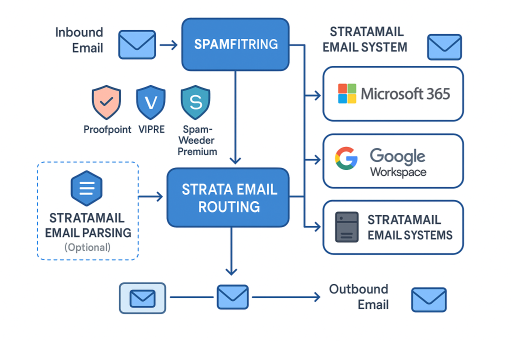
The spam filtering gateway is the first hop in your mail flow — MX records point here before mail reaches your primary server or continuity infrastructure. For regulated entities, the filtering layer must itself meet security and compliance expectations. We offer two tiers suited to regulated industry environments:
Proofpoint Essentials
The preferred choice for APRA-regulated entities and other financial services environments. Proofpoint is a globally recognised enterprise security platform with strong APAC presence and the compliance toolset that auditors expect to see.
- Enterprise DLP (Data Loss Prevention)
- Compliance reporting and audit trails
- Advanced phishing and BEC protection
- 30-day email continuity included
- Recognised brand for vendor due diligence
- $4.00–$4.95 per user / month
VIPRE Email Security
A strong choice for regulated entities with tighter per-user budgets or where advanced threat sandboxing is the primary security concern. VIPRE provides enterprise-grade protection at a mid-market price point.
- AI-powered phishing and malware detection
- Malware sandboxing and URL defense
- 90-day email continuity included
- BEC (Business Email Compromise) protection
- Streamlined admin dashboard
- $2.75–$2.95 per user / month
Infrastructure Components We Deploy
Beyond the filtering layer, a complete regulated-entity email continuity deployment involves the following components, each deployed at your facility of choice:
MX Backup / Mail Spooling
StrataMail Backup MX monitors your primary mail platform and queues inbound messages automatically during outages. When your server recovers, queued mail delivers in sequence with no message loss.
Core BCP component.
Continuity Mailbox (IMAP/SMTP)
A rolling-window archive VPS receives carbon copies of all inbound mail. During outages, users connect with their existing Outlook or mobile clients via standard IMAP/SMTP — no retraining required. Retention windows of 7 to 90 days.
Enables genuine IMAP/SMTP continuity.
Hybrid / Split Domain Routing
Where staff use multiple mail platforms under a shared domain, we implement split-domain routing so all addresses route correctly without breaking continuity coverage.
Optional — hybrid environments.
How the Engagement Works
We review your current email architecture, identify critical operation dependencies, and produce a written gap analysis against your applicable regulatory framework. This document has standalone value and can be presented to your compliance team or board.
We design a tailored solution with defined RTO/RPO commitments, component specifications, and a mail flow diagram suitable for inclusion in your BCP. Data residency and jurisdiction requirements are addressed at this stage.
We deploy on infrastructure in your preferred location — your own data center, a colocation facility in your jurisdiction, or our Knoxville facility for US-based requirements. Deploying on-shore resolves data sovereignty concerns entirely.
We conduct a documented failover test you can include in your BCP testing record and present to your board. We produce the full vendor due diligence package needed for your material service provider register submission to APRA.
Post-deployment monitoring, incident notification support, periodic failover re-testing, and engineering time on retainer. CPS-230 requires regular BCP testing — we can run that on your behalf and produce the documentation each cycle.
Regulatory Frameworks We Support
Our consulting engagements are not limited to APRA-regulated entities. The same infrastructure and documentation framework applies across a range of regulatory contexts:
What We Do — and What We Don't
We are a Knoxville, Tennessee-based data center and managed services provider operating under the Webservio brand. We are not an APRA-regulated entity, not an Australian company, and we do not provide legal or regulatory advice.
What we provide is the technical infrastructure, documented architecture, SLAs, tested failover procedures, and vendor due diligence materials that your compliance team and legal counsel need to formally satisfy your regulatory obligations. Deployment at an Australian colocation facility (your choice) resolves data sovereignty concerns entirely.
Next step
Talk to us about regulatory email compliance
Describe Your Challenge Schedule a CallNot ready to talk? Start with the Continuity Readiness Assessment, $499.
Or call 866.790.4678
Scope note: We provide technical implementation and documentation. Formal regulatory sign-off requires your compliance team or legal counsel.
Start here
Continuity Readiness Assessment — $499
What actually happens to your mail and your data in each failure mode, written down, with the gaps named.
What you get back
- Failure-mode walkthrough: provider outage, server loss, site loss, ransomware
- Your real recovery time and recovery point objectives as things stand today
- The gap between that and where you need to be
- Documentation suitable for an auditor or a board paper
Turnaround one week. If you go ahead with the work it recommends, the fee is credited against it in full.
Request the Continuity Readiness Assessment See consulting ratesTell us about your regulatory email compliance needs
Describe your situation and we will look into it and get back to you.
Describe Your Challenge Schedule a Call